How I build proprietary software systems with AI agents
Building software has changed a bit in the past year. I know, it's crazy. A year ago, we were impressed with how Claude Code could scaffold up a website but it still made so many mistakes. How many of you had broken arrays? Everyone. We have come so far; we've transcended the constant errors - or at least Claude or Codex is smart enough to correct itself before finishing your prompt. But we need to do more. We need to help these AI systems think like humans, remember like humans, and yes, maybe dream like humans. That's what I am attempting to do with the framework I will present in these articles. Maybe you'll read this and be inspired to try building on your own. Maybe you'll just call me to chat about it - or tell me why I'm wrong.
Step One - Log Everything Your Users Do
Log everything in your system. You have to have data in order for agentic systems to learn. This means you need to log every data pull and every data put. This way you'll know how long it took the humans to perform a task. You can detect time wasted. Maybe you'll get an error you can act on. Don't just let your AI tell you what to log, be specific. Log the number of rows. Log the amount of data sent or received. Classify the module. Track the user. Date time stamp everything.
Here's an abstract data model for logging events:
- Actors - these are the people and agents working in your system
- Category - these are the big picture areas of your software - sales, purchasing, inventory, product catalog, etc
- Module - these are the specific areas of your system such as order entry which is part of the sales category
- Events - the actual log of events, date time stamped, include row count, data, get or put, etc
Remember your primary and foreign keys - be sure all tables are completely normalized - no embedded info in the primary keys, foreign keys to connect tables. Prefix all your entities with a evt. or mem. so everything is easily searched in the database. Oh ya, almost forget, this is a database technique, not a text file technique. You have to be willing to get under the hood and add some tables to your ERP, CRM, CMS or whatever other acronym thang you're building.
Recording the Events
Now that we have the data model set up, we have to set up triggers in the database so every event is recorded. If you give an AI a data model and ask it to build the triggers, it should be able to do this without much back talk. The art is in the data model. Just tell it not to miss any tables. This will cover all the table updates or data puts completely. The data reads or gets also need to be recorded so we can time how long users were "looking" at something or handling data entry. This should be done with hooks from your software system. Again, the AI agent has the data model, so writing the hooks should be easy for it to carry out.
Don't complain about excessive amounts of data being collected yet. Because we are building our agentic systems to be more like humans, we are going to teach the system to forget about the past. We really don't care how somebody updated a purchase order three years ago - we care how they did it last week.
Trick Number Two - Store the AI prompts used to build the system
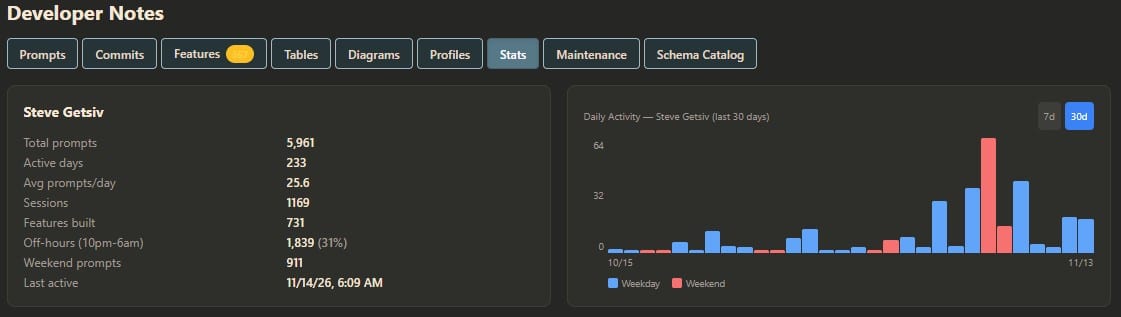
I've been doing this since January of 2026. Every project I work on. Every prompt gets stored in whatever database back end we are using. At first I wasn't sure what I would do with all the prompt data but then I found some use cases. Of course, the system now has a record of exactly how I built every project. That's a good thing when another developer comes on the team and can ask the AI how in the fuck Steve built a particular module. (sorry if you're sensitive to cussin', it's just how I express myself)
Here's an awesome use case for recording your prompts - a heat map to show your particular level of obsessiveness with AI.
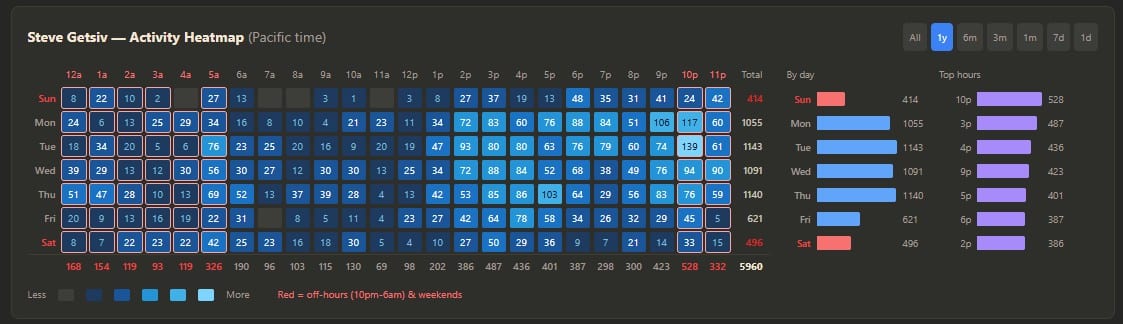
Of course I classify all my prompts by category and module. Eventually, the agents working autonomously will do the same.
I think that's enough for my first computer science-y post. I truly believe that AI is eventually going to level the playing field across any industry. It should make us all better, more efficient, less time doing administrative tasks, more time managing the big picture, it should lower costs so we can charge less for products (yes, my cup is half full). I'm an optimist. I'm an engineer. I am not afraid to get under the hood and start tinkering - and dreaming.